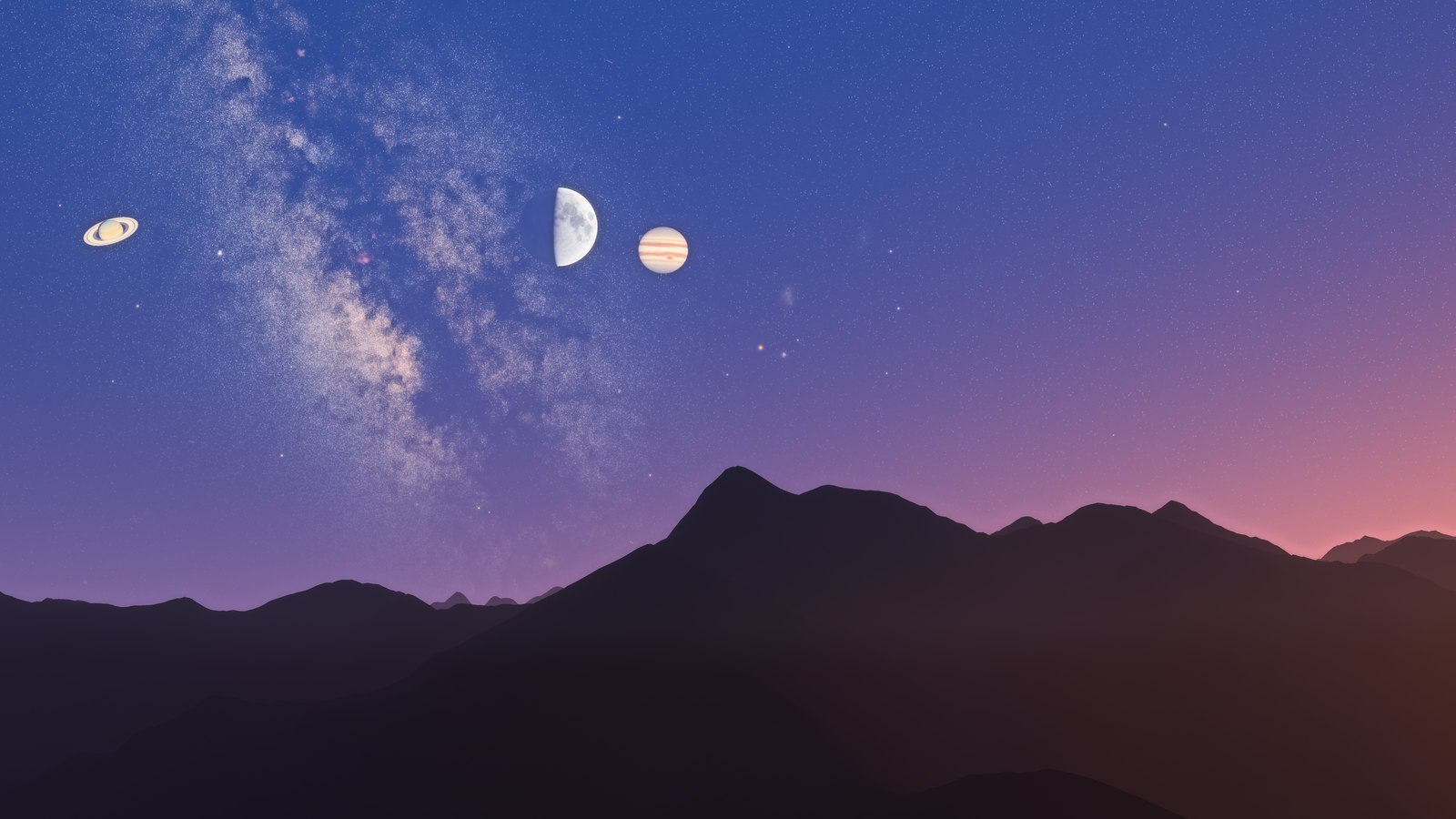
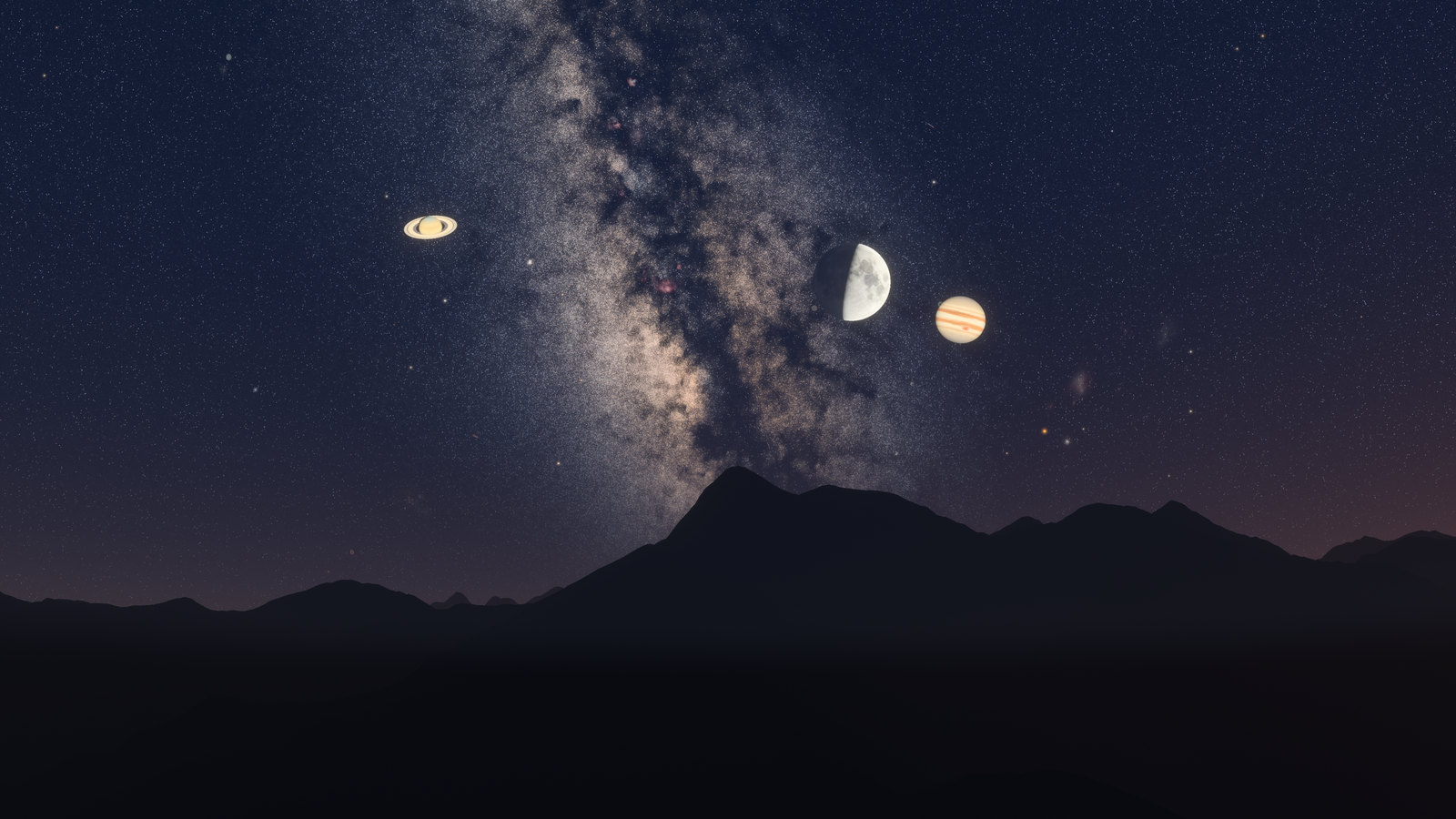
Edelweißspitze47.1236° N · 12.8311° EFriday · 6 September 2019 · 21:00positions true to the sky · moon, planets and nebulae enlarged
Edelweißspitze47.1236° N · 12.8311° EFriday · 6 September 2019 · 21:00positions true to the sky · moon, planets and nebulae enlarged
Print
The same print without a frame, for the frame you already have in mind. Portrait or landscape, with the horizon of your place along the foot, or the whole sky in one circle.
The stars come round again each year. The Moon and the planets among them never stand the same way twice. We compute the sky that stood over your place at your minute, and make it an artwork.
You tell us three things.
Place
Anywhere on Earth: a city, a village, a summit.
Moment
A date and a time, to the minute. Any day from 1900 to 2050.
Words
Names, or a line of your own, set beneath the sky.
From these we work out where the Moon, the planets and every star you could have seen stood above you. We draw the Milky Way behind them and raise the real skyline of your place in front.
Look again.
Everything is where it was. Point at a light to read what it is.
21:00 over the Edelweißspitze
13.8° the Sun below the horizon
2,267 stars above the horizon bright enough for the naked eye
waxing gibbous Moon
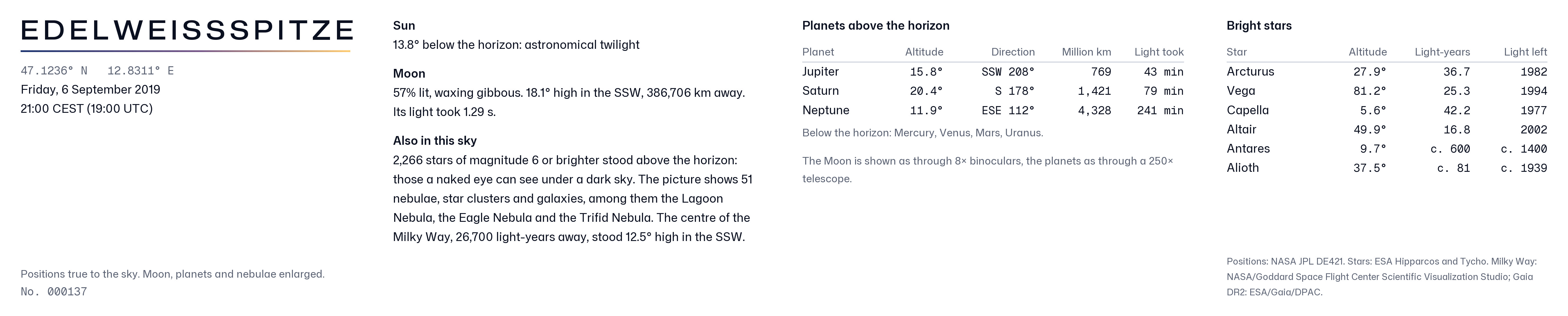
The Almanac
An almanac is a table of the sky for given dates. Ours is for a single minute: yours.
It lists each body that stood above you:
How high it stood, and in which direction
How far away it was
How long its light had been on the way
It comes with every print as a card, numbered. If you like, we also print it on the front, beneath the sky.
The light of Vega in this sky set out in 1994.
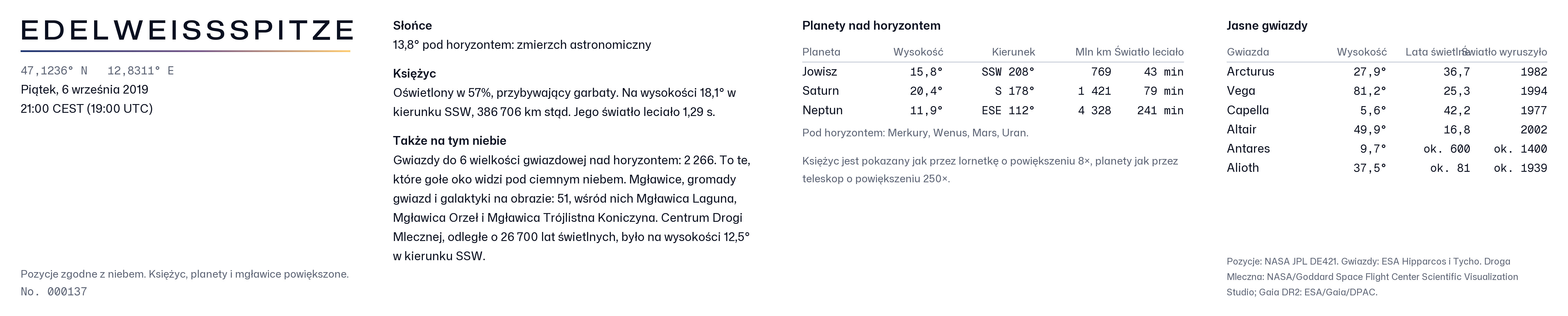
No. 000137
Almanac
Edelweißspitze, Hohe Tauern, Austria
47.1236° N12.8311° E, 2571 m Friday 6 September 2019, 21:00 CEST (19:00 UTC)
Sun and Moon
Sun
13.8° below the horizon: astronomical twilight
Moon
57% lit, waxing gibbous. 18.1° high in the SSW, 386,706 km away. Its light took 1.29 s.
Planets above the horizon
Planet
Altitude
Direction
Million km
Light took
Jupiter
15.8°
SSW 208°
769
43 min
Saturn
20.4°
S 178°
1,421
79 min
Neptune
11.9°
ESE 112°
4,328
241 min
Below the horizon: Mercury, Venus, Mars, Uranus.
Bright stars
Star
Altitude
Direction
Light-years
Light left
Arcturus
27.9°
W 268°
36.7
1982
Vega
81.2°
SSW 201°
25.3
1994
Capella
5.6°
NNE 16°
42.2
1977
Altair
49.9°
SSE 157°
16.8
2002
Antares
9.7°
SSW 212°
c. 600
c. 1400
Alioth
37.5°
NW 315°
c. 81
c. 1939
Also in this sky
2,267 stars of magnitude 6 or brighter stood above the horizon: those a naked eye can see under a dark sky. The picture shows 55 nebulae, star clusters and galaxies, among them the Lagoon Nebula, the Eagle Nebula and the Trifid Nebula. The centre of the Milky Way, 26,700 light-years away, stood 12.5° high in the SSW.
Positions: NASA JPL DE421. Stars: ESA Hipparcos and Tycho. Milky Way: NASA/Goddard Space Flight Center Scientific Visualization Studio; Gaia DR2: ESA/Gaia/DPAC. Christopher Granabetter, astrophysicist, Vienna
No. 000137
Almanach
Edelweißspitze, Hohe Tauern, Österreich
47,1236° N12,8311° O, 2571 m Freitag 6. September 2019, 21:00 MESZ (19:00 UTC)
Sonne und Mond
Sonne
13,8° unter dem Horizont: astronomische Dämmerung
Mond
Zu 57 % beleuchtet, zunehmender Mond. 18,1° hoch im SSW, 386.706 km entfernt. Sein Licht brauchte 1,29 s.
Planeten über dem Horizont
Planet
Höhe
Richtung
Mio. km
Lichtlaufzeit
Jupiter
15,8°
SSW 208°
769
43 min
Saturn
20,4°
S 178°
1.421
79 min
Neptun
11,9°
OSO 112°
4.328
241 min
Unter dem Horizont: Merkur, Venus, Mars, Uranus.
Helle Sterne
Stern
Höhe
Richtung
Lichtjahre
Licht von
Arcturus
27,9°
W 268°
36,7
1982
Vega
81,2°
SSW 201°
25,3
1994
Capella
5,6°
NNO 16°
42,2
1977
Altair
49,9°
SSO 157°
16,8
2002
Antares
9,7°
SSW 212°
ca. 600
ca. 1400
Alioth
37,5°
NW 315°
ca. 81
ca. 1939
Außerdem an diesem Himmel
2.267 Sterne der Größenklasse 6 oder heller standen über dem Horizont: jene, die das bloße Auge unter dunklem Himmel sieht. Das Bild zeigt 55 Nebel, Sternhaufen und Galaxien, darunter Lagunennebel, Adlernebel und Trifidnebel. Das Zentrum der Milchstraße, 26.700 Lichtjahre entfernt, stand 12,5° hoch im SSW.
Positionen: NASA JPL DE421. Sterne: ESA Hipparcos und Tycho. Milchstraße: NASA/Goddard Space Flight Center Scientific Visualization Studio; Gaia DR2: ESA/Gaia/DPAC. Christopher Granabetter, Astrophysiker, Wien
No. 000137
Almanaque
Edelweißspitze, Hohe Tauern, Austria
47,1236° N12,8311° E, 2571 m Viernes 6 de septiembre de 2019, 21:00 CEST (19:00 UTC)
Sol y Luna
Sol
13,8° bajo el horizonte: crepúsculo astronómico
Luna
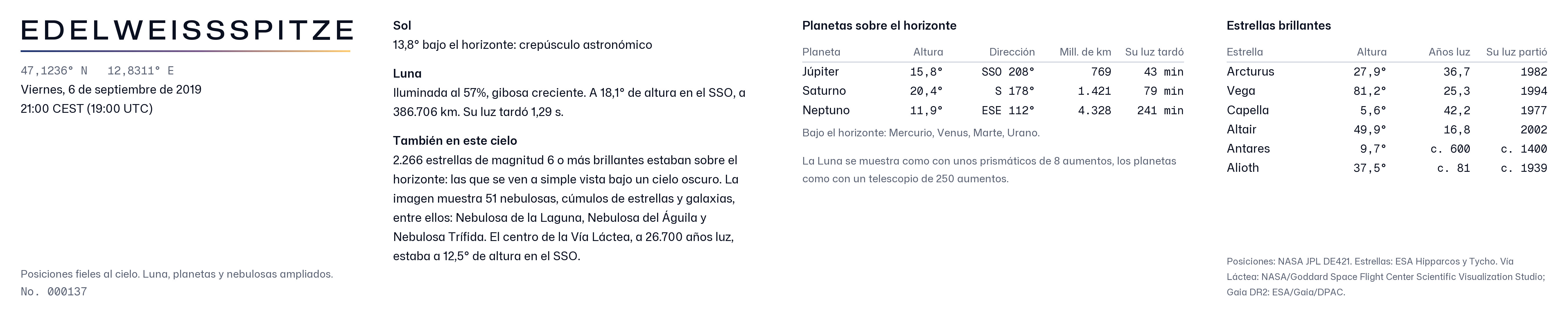
Iluminada al 57%, gibosa creciente. A 18,1° de altura en el SSO, a 386.706 km. Su luz tardó 1,29 s.
Planetas sobre el horizonte
Planeta
Altura
Dirección
Mill. de km
Su luz tardó
Júpiter
15,8°
SSO 208°
769
43 min
Saturno
20,4°
S 178°
1.421
79 min
Neptuno
11,9°
ESE 112°
4.328
241 min
Bajo el horizonte: Mercurio, Venus, Marte, Urano.
Estrellas brillantes
Estrella
Altura
Dirección
Años luz
Su luz partió
Arcturus
27,9°
O 268°
36,7
1982
Vega
81,2°
SSO 201°
25,3
1994
Capella
5,6°
NNE 16°
42,2
1977
Altair
49,9°
SSE 157°
16,8
2002
Antares
9,7°
SSO 212°
c. 600
c. 1400
Alioth
37,5°
NO 315°
c. 81
c. 1939
También en este cielo
2.267 estrellas de magnitud 6 o más brillantes estaban sobre el horizonte: las que se ven a simple vista bajo un cielo oscuro. La imagen muestra 55 nebulosas, cúmulos de estrellas y galaxias, entre ellos: Nebulosa de la Laguna, Nebulosa del Águila y Nebulosa Trífida. El centro de la Vía Láctea, a 26.700 años luz, estaba a 12,5° de altura en el SSO.
Posiciones: NASA JPL DE421. Estrellas: ESA Hipparcos y Tycho. Vía Láctea: NASA/Goddard Space Flight Center Scientific Visualization Studio; Gaia DR2: ESA/Gaia/DPAC. Christopher Granabetter, astrofísico, Viena
No. 000137
Almanaque
Edelweißspitze, Hohe Tauern, Austria
47,1236° N12,8311° E, 2571 m Sexta-feira 6 de setembro de 2019, 21:00 CEST (19:00 UTC)
Sol e Lua
Sol
13,8° abaixo do horizonte: crepúsculo astronómico
Lua
57% iluminada, gibosa crescente. A 18,1° de altura a SSO, a 386.706 km. A sua luz demorou 1,29 s.
Planetas acima do horizonte
Planeta
Altura
Direção
Milhões de km
A luz demorou
Júpiter
15,8°
SSO 208°
769
43 min
Saturno
20,4°
S 178°
1.421
79 min
Neptuno
11,9°
ESE 112°
4.328
241 min
Abaixo do horizonte: Mercúrio, Vénus, Marte, Urano.
Estrelas brilhantes
Estrela
Altura
Direção
Anos-luz
A luz partiu
Arcturus
27,9°
O 268°
36,7
1982
Vega
81,2°
SSO 201°
25,3
1994
Capella
5,6°
NNE 16°
42,2
1977
Altair
49,9°
SSE 157°
16,8
2002
Antares
9,7°
SSO 212°
c. 600
c. 1400
Alioth
37,5°
NO 315°
c. 81
c. 1939
Também neste céu
2.267 estrelas de magnitude 6 ou mais brilhantes estavam acima do horizonte: as que se veem a olho nu sob um céu escuro. A imagem mostra 55 nebulosas, enxames de estrelas e galáxias, entre eles: Nebulosa da Lagoa, Nebulosa da Águia e Nebulosa Trífida. O centro da Via Láctea, a 26.700 anos-luz, estava a 12,5° de altura a SSO.
Posições: NASA JPL DE421. Estrelas: ESA Hipparcos e Tycho. Via Láctea: NASA/Goddard Space Flight Center Scientific Visualization Studio; Gaia DR2: ESA/Gaia/DPAC. Christopher Granabetter, astrofísico, Viena
No. 000137
Almanach
Edelweißspitze, Hohe Tauern, Austria
47,1236° N12,8311° E, 2571 m Vendredi 6 septembre 2019, 21:00 CEST (19:00 UTC)
Soleil et Lune
Soleil
13,8° sous l’horizon : crépuscule astronomique
Lune
Éclairée à 57 %, gibbeuse croissante. À 18,1° de hauteur, direction SSO, à 386 706 km. Sa lumière a mis 1,29 s.
Planètes au-dessus de l’horizon
Planète
Hauteur
Direction
Millions de km
Temps-lumière
Jupiter
15,8°
SSO 208°
769
43 min
Saturne
20,4°
S 178°
1 421
79 min
Neptune
11,9°
ESE 112°
4 328
241 min
Sous l’horizon : Mercure, Vénus, Mars, Uranus.
Étoiles brillantes
Étoile
Hauteur
Direction
Années-lumière
Lumière partie
Arcturus
27,9°
O 268°
36,7
1982
Vega
81,2°
SSO 201°
25,3
1994
Capella
5,6°
NNE 16°
42,2
1977
Altair
49,9°
SSE 157°
16,8
2002
Antares
9,7°
SSO 212°
env. 600
env. 1400
Alioth
37,5°
NO 315°
env. 81
env. 1939
Également dans ce ciel
2 267 étoiles de magnitude 6 ou plus brillantes se trouvaient au-dessus de l’horizon : celles que l’œil nu peut voir sous un ciel sombre. L’image montre 55 nébuleuses, amas d’étoiles et galaxies, parmi lesquels Nébuleuse de la Lagune, Nébuleuse de l’Aigle et Nébuleuse Trifide. Le centre de la Voie lactée, à 26 700 années-lumière, se trouvait à 12,5° de hauteur, direction SSO.
Positions : NASA JPL DE421. Étoiles : ESA Hipparcos et Tycho. Voie lactée : NASA/Goddard Space Flight Center Scientific Visualization Studio ; Gaia DR2 : ESA/Gaia/DPAC. Christopher Granabetter, astrophysicien, Vienne
No. 000137
Almanacco
Edelweißspitze, Hohe Tauern, Austria
47,1236° N12,8311° E, 2571 m Venerdì 6 settembre 2019, 21:00 CEST (19:00 UTC)
Sole e Luna
Sole
13,8° sotto l’orizzonte: crepuscolo astronomico
Luna
Illuminata al 57%, gibbosa crescente. A 18,1° di altezza in direzione SSO, a 386.706 km. La sua luce ha impiegato 1,29 s.
Pianeti sopra l’orizzonte
Pianeta
Altezza
Direzione
Milioni di km
Tempo luce
Giove
15,8°
SSO 208°
769
43 min
Saturno
20,4°
S 178°
1.421
79 min
Nettuno
11,9°
ESE 112°
4.328
241 min
Sotto l’orizzonte: Mercurio, Venere, Marte, Urano.
Stelle luminose
Stella
Altezza
Direzione
Anni luce
Luce partita
Arcturus
27,9°
O 268°
36,7
1982
Vega
81,2°
SSO 201°
25,3
1994
Capella
5,6°
NNE 16°
42,2
1977
Altair
49,9°
SSE 157°
16,8
2002
Antares
9,7°
SSO 212°
ca. 600
ca. 1400
Alioth
37,5°
NO 315°
ca. 81
ca. 1939
Anche in questo cielo
2.267 stelle di magnitudine 6 o più luminose erano sopra l’orizzonte: quelle che l’occhio nudo vede sotto un cielo buio. L’immagine mostra 55 nebulose, ammassi stellari e galassie, tra cui: Nebulosa Laguna, Nebulosa Aquila e Nebulosa Trifida. Il centro della Via Lattea, a 26.700 anni luce, era a 12,5° di altezza in direzione SSO.
Posizioni: NASA JPL DE421. Stelle: ESA Hipparcos e Tycho. Via Lattea: NASA/Goddard Space Flight Center Scientific Visualization Studio; Gaia DR2: ESA/Gaia/DPAC. Christopher Granabetter, astrofisico, Vienna
No. 000137
Almanach
Edelweißspitze, Hohe Tauern, Austria
47,1236° N12,8311° E, 2571 m Piątek 6 września 2019, 21:00 CEST (19:00 UTC)
Słońce i Księżyc
Słońce
13,8° pod horyzontem: zmierzch astronomiczny
Księżyc
Oświetlony w 57%, przybywający garbaty. Na wysokości 18,1° w kierunku SSW, 386 706 km stąd. Jego światło leciało 1,29 s.
Planety nad horyzontem
Planeta
Wysokość
Kierunek
Mln km
Światło leciało
Jowisz
15,8°
SSW 208°
769
43 min
Saturn
20,4°
S 178°
1 421
79 min
Neptun
11,9°
ESE 112°
4 328
241 min
Pod horyzontem: Merkury, Wenus, Mars, Uran.
Jasne gwiazdy
Gwiazda
Wysokość
Kierunek
Lata świetlne
Światło wyruszyło
Arcturus
27,9°
W 268°
36,7
1982
Vega
81,2°
SSW 201°
25,3
1994
Capella
5,6°
NNE 16°
42,2
1977
Altair
49,9°
SSE 157°
16,8
2002
Antares
9,7°
SSW 212°
ok. 600
ok. 1400
Alioth
37,5°
NW 315°
ok. 81
ok. 1939
Także na tym niebie
Gwiazdy do 6 wielkości gwiazdowej nad horyzontem: 2 267. To te, które gołe oko widzi pod ciemnym niebem. Mgławice, gromady gwiazd i galaktyki na obrazie: 55, wśród nich Mgławica Laguna, Mgławica Orzeł i Mgławica Trójlistna Koniczyna. Centrum Drogi Mlecznej, odległe o 26 700 lat świetlnych, było na wysokości 12,5° w kierunku SSW.
Pozycje: NASA JPL DE421. Gwiazdy: ESA Hipparcos i Tycho. Droga Mleczna: NASA/Goddard Space Flight Center Scientific Visualization Studio; Gaia DR2: ESA/Gaia/DPAC. Christopher Granabetter, astrofizyk, Wiedeń
No. 000137
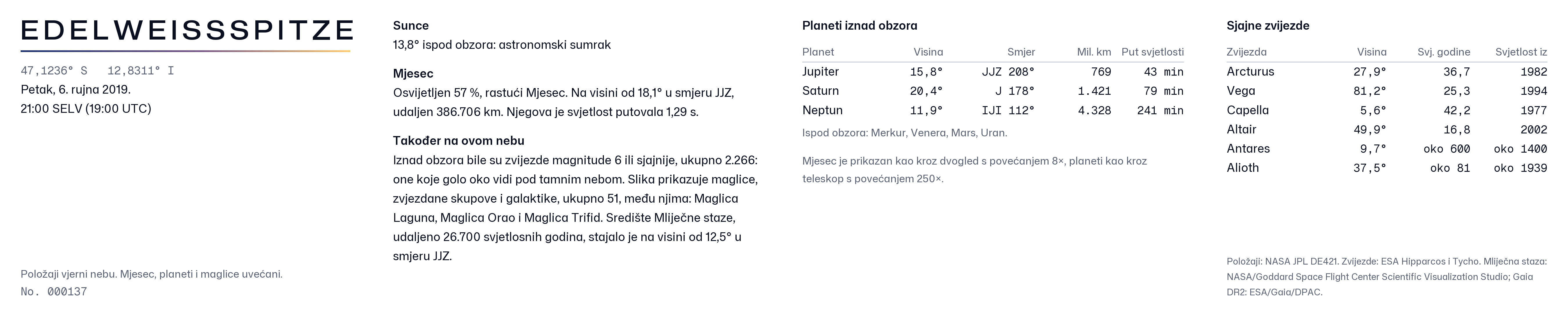
Almanah
Edelweißspitze, Hohe Tauern, Austria
47,1236° S12,8311° I, 2571 m Petak 6. rujna 2019., 21:00 SELV (19:00 UTC)
Sunce i Mjesec
Sunce
13,8° ispod obzora: astronomski sumrak
Mjesec
Osvijetljen 57 %, rastući Mjesec. Na visini od 18,1° u smjeru JJZ, udaljen 386.706 km. Njegova je svjetlost putovala 1,29 s.
Planeti iznad obzora
Planet
Visina
Smjer
Mil. km
Put svjetlosti
Jupiter
15,8°
JJZ 208°
769
43 min
Saturn
20,4°
J 178°
1.421
79 min
Neptun
11,9°
IJI 112°
4.328
241 min
Ispod obzora: Merkur, Venera, Mars, Uran.
Sjajne zvijezde
Zvijezda
Visina
Smjer
Svj. godine
Svjetlost iz
Arcturus
27,9°
Z 268°
36,7
1982
Vega
81,2°
JJZ 201°
25,3
1994
Capella
5,6°
SSI 16°
42,2
1977
Altair
49,9°
JJI 157°
16,8
2002
Antares
9,7°
JJZ 212°
oko 600
oko 1400
Alioth
37,5°
SZ 315°
oko 81
oko 1939
Također na ovom nebu
Iznad obzora bile su zvijezde magnitude 6 ili sjajnije, ukupno 2.267: one koje golo oko vidi pod tamnim nebom. Slika prikazuje maglice, zvjezdane skupove i galaktike, ukupno 55, među njima: Maglica Laguna, Maglica Orao i Maglica Trifid. Središte Mliječne staze, udaljeno 26.700 svjetlosnih godina, stajalo je na visini od 12,5° u smjeru JJZ.
Položaji: NASA JPL DE421. Zvijezde: ESA Hipparcos i Tycho. Mliječna staza: NASA/Goddard Space Flight Center Scientific Visualization Studio; Gaia DR2: ESA/Gaia/DPAC. Christopher Granabetter, astrofizičar, Beč
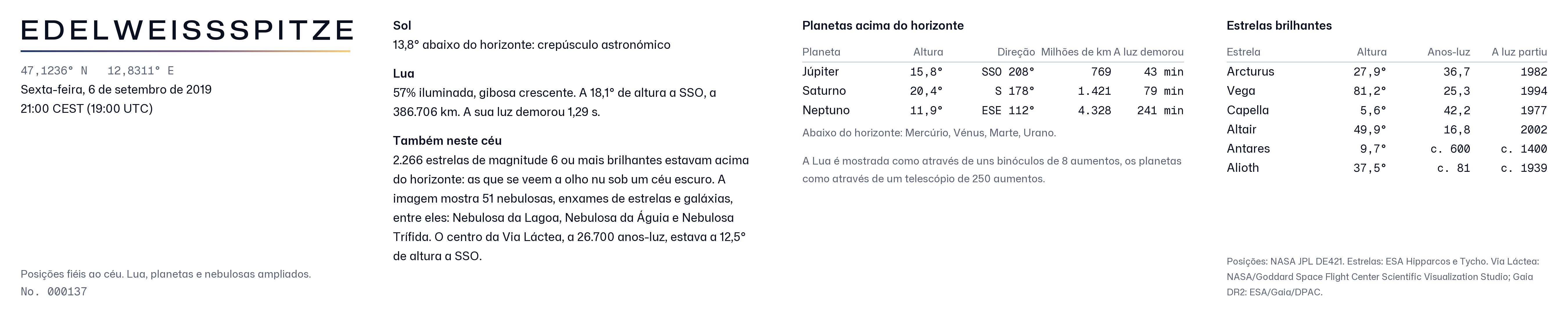
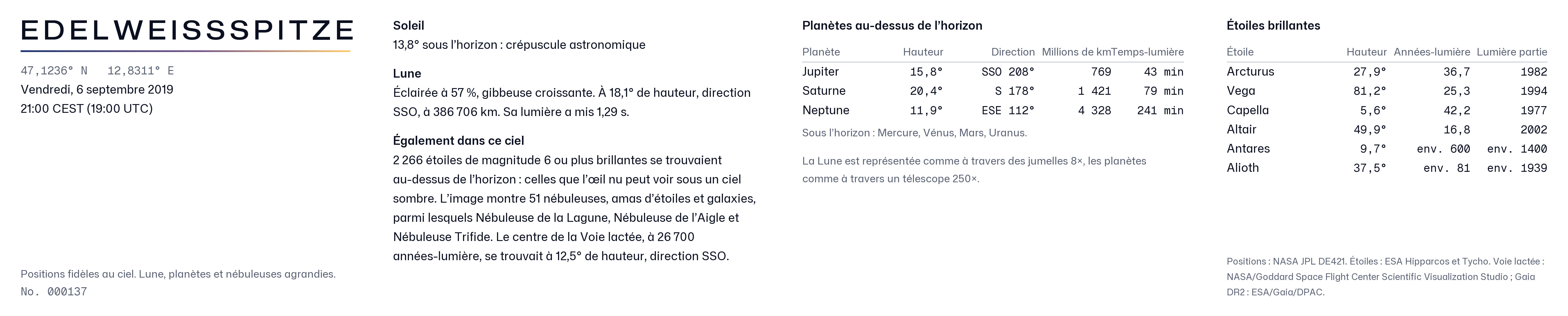
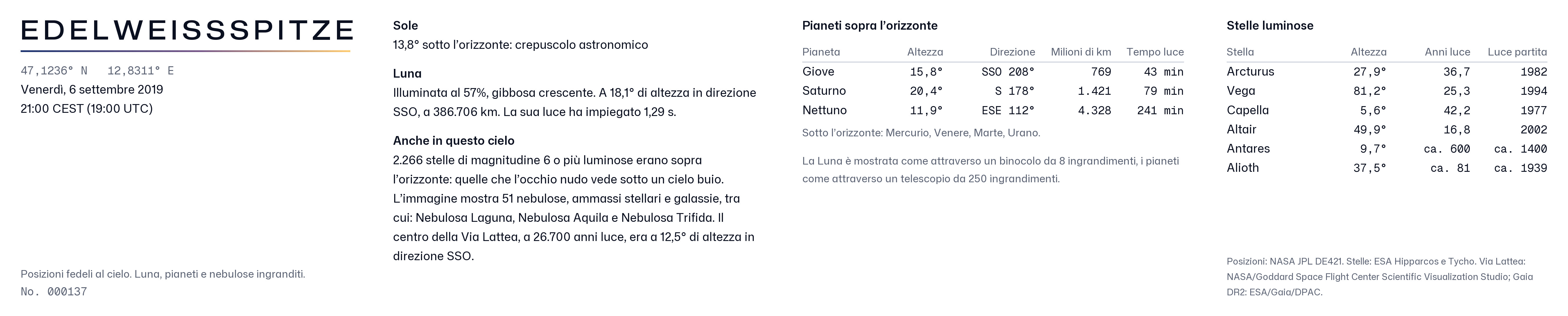
The Almanac as it prints on the front of a 50 × 70 cm print. Open it at full size.The Almanac as it prints on the front of a 50 × 70 cm print. Open it at full size.The Almanac as it prints on the front of a 50 × 70 cm print. Open it at full size.The Almanac as it prints on the front of a 50 × 70 cm print. Open it at full size.The Almanac as it prints on the front of a 50 × 70 cm print. Open it at full size.The Almanac as it prints on the front of a 50 × 70 cm print. Open it at full size.The Almanac as it prints on the front of a 50 × 70 cm print. Open it at full size.The Almanac as it prints on the front of a 50 × 70 cm print. Open it at full size.
Made to be looked at closely.
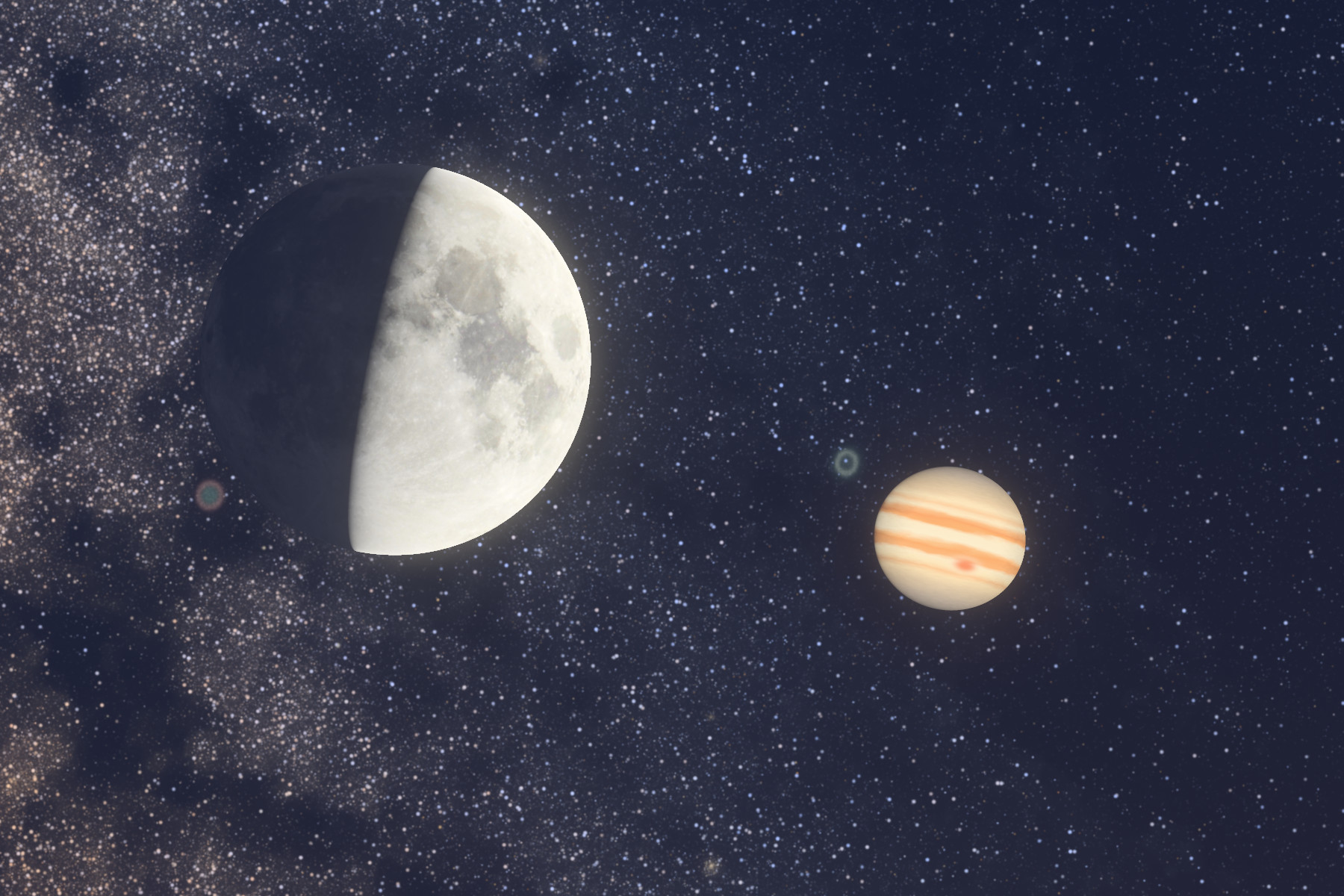
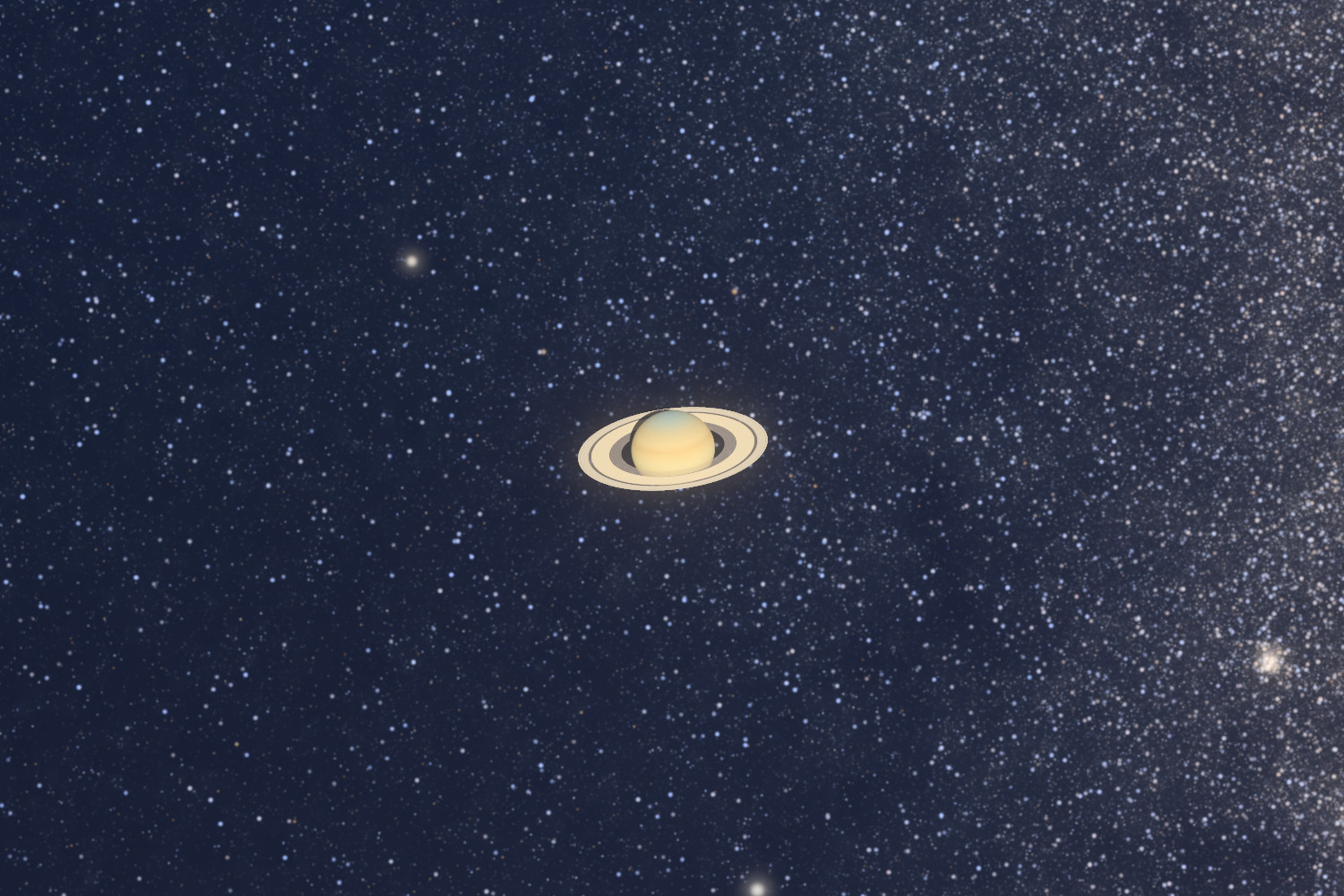
A 50 × 70 cm print holds 5906 × 8268 pixels. These three pieces are cut from it. Open one to see it pixel for pixel.
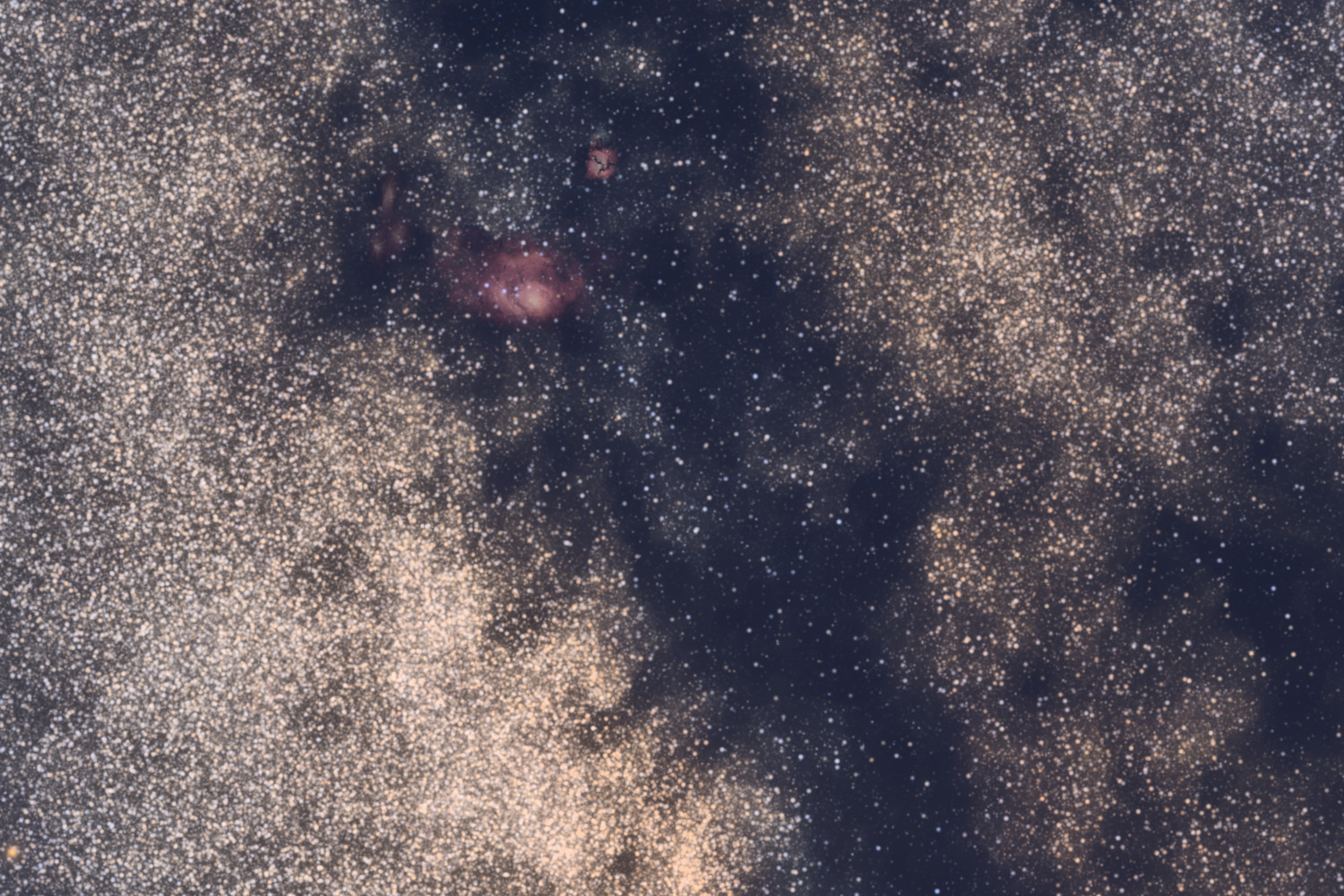
5 cm on the printThe Moon, 57% lit, and Jupiter. That evening the Moon was 386,706 km away, Jupiter 769 million.5 cm on the printSaturn, its rings tilted 25° towards us. Its light had been on the way for 79 minutes.5 cm on the printThe Lagoon and the Trifid Nebula among the star clouds towards the centre of our galaxy.
Six layers, one sky.
Each artwork is built in layers, from the galaxy to the ground, then graded like an astrophotograph.
Where things are. The Moon, the planets, every star you can see with the naked eye and every catalogued nebula and galaxy stand at their true positions. We never invent an event.
What we change, and say so
How large things appear. To the eye the Moon is half a degree wide and a planet is a point of light. We draw them larger, so you can see the phase of the Moon and the rings of Saturn. The caption says so. Ask for the true sky and everything keeps its real size.
Our special moment47.2692° N · 11.4041° ETuesday · 23 May 2023 · 21:25positions true to the sky · moon, planets and nebulae enlarged
Innsbruck23 May 2023, 21:25
The Moon, four days old, beside Venus in the last light. Mars stands above them.
Vienna48.2082° N · 16.3738° ESaturday · 1 January 2000 · 00:00positions true to the sky · moon, planets and nebulae enlarged
Vienna1 January 2000, 00:00
Orion and Sirius over the first minute of the year 2000.
Glacier Point37.7305° N · 119.5737° WFriday · 24 June 2022 · 04:50positions true to the sky · moon, planets and nebulae enlarged
Glacier Point24 June 2022, 04:50
Venus, the Moon, Mars and Jupiter in a line beside Half Dome, before sunrise.
The whole sky.
Every star above you at that minute, in one circle around the zenith. The skyline of your place is its rim; north, east, south and west stand around it.
Upright or on its side, as a print, framed, or as wallpaper for your phone, tablet and desktop. You choose which direction stands at the top.
I am an astrophysicist in Vienna, and I photograph the night sky myself.
I built Cosmoment to make a thoughtful gift: an artwork that brings the universe closer and shows the person who receives it what they mean, on the scale of the universe. It had to be an artwork and a true record of the sky at once.
So every artwork is computed from the data astronomers work with. And I check what the engine draws against my own photographs of the sky.
Christopher Granabetter
Questions
Is this the real sky?
Yes. The positions of the Sun, the Moon and the planets come from NASA JPL's ephemeris. The stars come from measured catalogues, the skyline from an elevation model of the Earth. We compute all of it for your place and your minute.
Why are the Moon and the planets so large?
So that you can see them. In the sky the Moon is half a degree wide, and Saturn's rings need a telescope. We draw the Moon, the planets and the nebulae larger than life and leave them exactly where they stood. The caption on every print says so, and you can ask for the true sky instead.
What if my moment was in daylight, or under clouds?
The stars were there all the same. We show the sky as it stood above the weather. A moment in daylight is shown as day. If you would rather see the stars of that minute, ask for the night view.
Which places and dates can you do?
Any place on Earth, and any minute from 1900 to 2050.
Can I send it back?
A personal artwork is made for you alone, so it cannot be returned unless something is wrong with it. The terms have the details.
Where does the data come from?
From NASA, ESA, the Copernicus programme and the people who keep the catalogues. Every source is named on the credits page. Cosmoment is not endorsed by NASA, ESA or any data provider.
You mean the universe to me.
Create your sky
Enter the date, the time and the place. Turn the sky to the view you want, add your words, and choose how it should reach you.